
Across the Andes and the mining frontiers of South America, the hardest part of running an operation is often not the ore — it is the power. And the way that power is delivered is changing fast.
South America holds some of the world's richest copper, gold and lithium reserves, and much of it sits far from any dependable grid. Mines in the high Andes, in the Amazon basin and along remote frontier corridors have historically had two options: extend a transmission line over punishing terrain, or install a large, permanent diesel power station on site. Both are slow, capital-heavy, and inflexible — and both tend to lock an operation into a fixed block of capacity years before anyone knows how the mine will actually ramp.
A third option has now matured to the point where it is displacing the old model outright: modular, containerized generation that synchronizes in parallel. Instead of one oversized plant, the site runs a bank of standardized generating units housed in ISO shipping containers — deployed in weeks, scaled in modules, and controlled as a single intelligent system.
The problem with the old model
A single large genset sized for a mine's peak demand spends most of its life running well below that peak. Diesel engines are least efficient at part load, so an oversized plant quietly burns money every hour it runs. Worse, a single machine is a single point of failure: when it goes down for maintenance or fault, so does the mine.
Permanent power stations also assume you already know the answer. Mining loads rarely stand still — a plant grows with each phase of development, a new grinding line or a dewatering pump can shift the peak overnight, and exploration can extend the mine life far beyond the original power design. Committing to fixed capacity up front means either over-building (and paying for idle iron) or under-building (and throttling production later).
What "containerized" actually changes
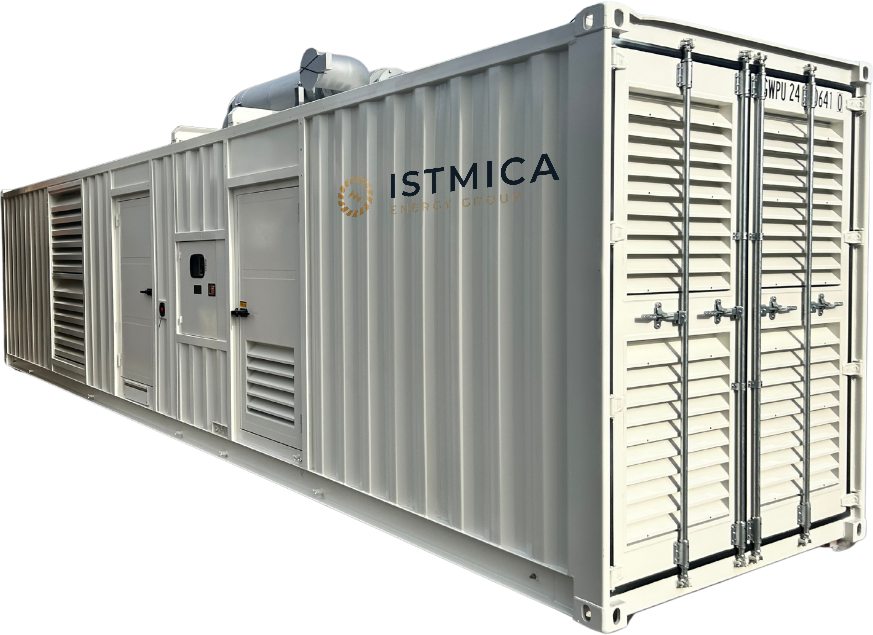
A containerized unit is a complete generating set — engine, alternator, controls, fuel tank and protection — pre-integrated inside a standard ISO container at the factory. It ships on any truck, rail or vessel that moves containers, lands on a prepared pad, and connects: plug and play. There is no civil power-house to build, no months of on-site assembly.
Because the format is standardized, capacity becomes something you add rather than something you predict. A 20-foot unit carries a single generator; a 40-foot unit carries two. Units are engineered to run individually or to be synchronized in parallel — matching frequency, voltage and phase before connecting to a common busbar — so the plant can start small and grow container by container, without ever taking the existing supply offline.
Example containerized configuration
| Format | 20'HQ (1 genset) · 40'HQ (2 gensets), standard ISO container |
| Output per container | 1.1 MW (20'HQ) · 2.2 MW (40'HQ) |
| Rated capacity | 1,375 kVA (20'HQ) · 2,750 kVA (40'HQ) |
| Engine | Cummins KTA50-G3, 4-stroke diesel |
| Output voltage | 440 V – 11.5 kV |
| Frequency | 60 Hz |
| Control & monitoring | AMF / PLC panel, automatic electric start |
| Protection | IP44 standard (IP54 / IP63 optional) |
| Acoustic | Sound-attenuated (soundproof) container |
| Fuel tank | 1,500 L per genset |
| Installation | Plug & play |
Fuel savings through smart synchronization
The single biggest operating cost at a remote mine is fuel, and this is where synchronization earns its keep. A parallel-connected bank of units is managed by an automatic load-control system that watches the real load on the busbar and brings units online or takes them offline to match it. Rather than running four engines at 40% each, the system might run two near their most efficient point and rest the others.
The effect is direct: keeping every running engine close to its optimal loading, and shutting down capacity that isn't needed, can reduce fuel consumption by as much as 30% compared with a static, oversized plant. On a diesel mine site — where fuel is trucked in over long distances — that is a decisive line on the operating budget, and it compounds every single day the plant runs.
Automatic load management also protects the engines themselves. Diesels dislike sustained light loading; running the right number of units at healthy load reduces wet-stacking and maintenance, and extends service life.
Reliability by design: the spare unit and ATS
Downtime at a producing mine is measured in lost tonnes, so backup cannot be an afterthought. The containerized approach builds it into the topology. Alongside the running units, a spare generating unit sits on standby, tied to the busbar through an Automatic Transfer Switch (ATS). If any running unit trips or is taken out for service, the ATS transfers the load and the standby unit picks it up automatically — with no manual intervention and no interruption to the operation.
This is classic N+1 redundancy, delivered in a modular package: the plant always has at least one more unit than the load strictly requires. Combined with parallel synchronization, it means a fault in one machine is a non-event for the mine rather than a production stoppage.
- Automatic synchronization — units match frequency, voltage and phase before paralleling to the busbar.
- Load-following control — units start and stop with demand, cutting fuel use up to 30%.
- Modular scalability — add containers in parallel to grow capacity without interrupting supply.
- ATS-backed standby — a reserve unit takes over automatically on any fault, for continuous power.
Sizing for the Andes: altitude, heat and humidity
One caution specific to South America: a generator's nameplate rating is quoted at reference conditions, and real sites are rarely reference conditions. At the altitudes common to Andean mining, thinner air reduces an engine's output, and high ambient temperature and humidity derate it further. A plant specified at sea level can fall well short once it is installed at 3,000 or 4,000 metres.
This is exactly why the containerized model pairs so well with engineering-led sizing. Because capacity is modular, the derated output at the real site conditions can be met by adding units rather than discovering a shortfall after commissioning — and the load-control system keeps the derated fleet running efficiently.
The bottom line
For off-grid and grid-edge mines in South America, containerized, synchronized power turns electricity from a fixed, front-loaded liability into a flexible system that tracks the operation. It deploys in weeks instead of quarters, scales with each phase of the mine, cuts fuel through intelligent load-following, and keeps producing through faults thanks to a standby unit on ATS. As pressure grows on both cost and uptime, that combination is why the containerized approach is quickly becoming the default — not the alternative.
Planning power for a remote site?
Tell us your load, your site conditions and your fuel supply — our engineers will design a containerized configuration sized to your operation, with a USD proposal.
Request a Power Assessment →