
A generator's nameplate tells you what it produces under laboratory reference conditions. Your site is not a laboratory — and in much of Latin America, the gap between the two is large enough to decide whether a plant works.
Specify a 1,000 kW generating set and it is reasonable to assume you will get 1,000 kW. But that figure is quoted at defined reference conditions, and the further your site sits from them, the less power the same machine will actually deliver. Engineers call this loss derating, and the three factors that drive it — altitude, temperature and humidity — are exactly the conditions that dominate mine sites in the Andes and industrial sites across the Caribbean and Amazon.
Ignore derating and you specify a plant that looks right on paper and falls short in the field. Account for it, and you size once, correctly.
Why an engine loses power
A diesel or gas engine is, fundamentally, an air pump: it can only burn as much fuel as it has oxygen to burn it with. Anything that reduces the density of the air going into the engine reduces how much fuel it can combust per stroke — and therefore how much power it makes. Altitude, heat and humidity all thin the air out, each in its own way.
The alternator has its own limit. Its output is capped by how hot its windings are allowed to get, so a high ambient temperature eats into the alternator's rating too — independently of the engine. Derating is really the combination of both effects.
Altitude: thinner air, less power
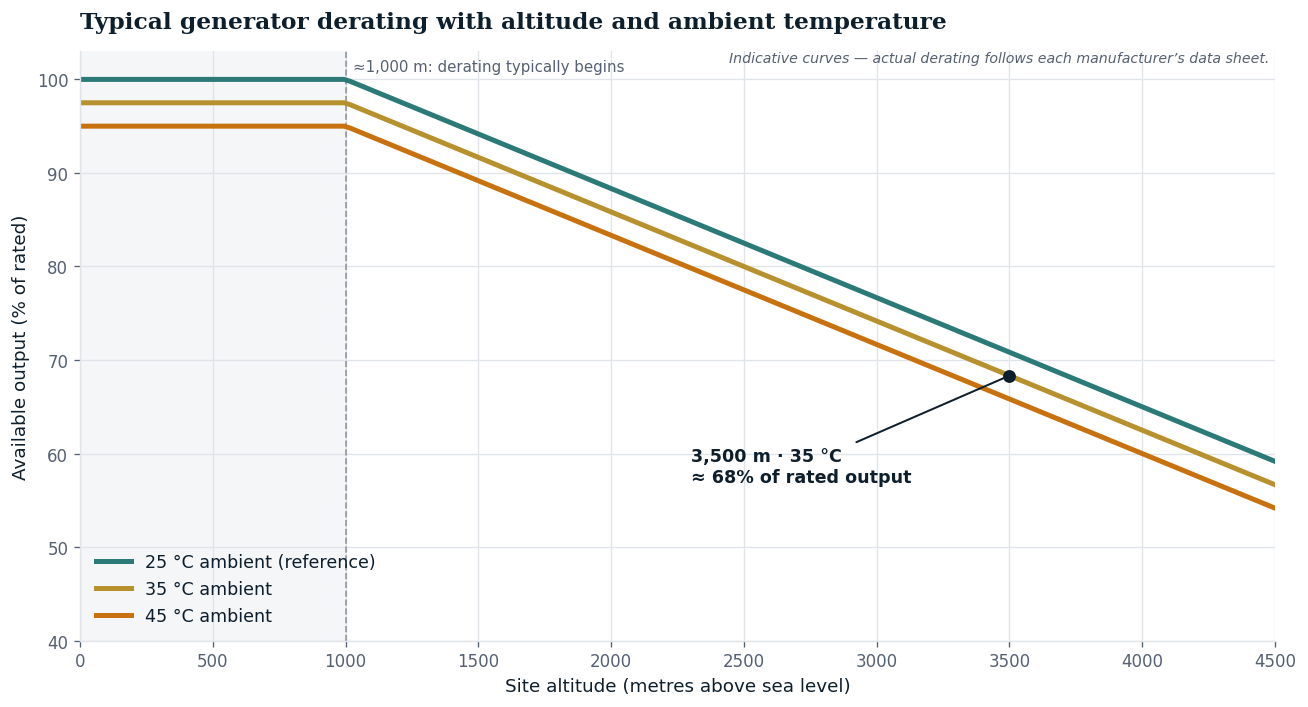
As you climb, atmospheric pressure and air density fall. Above roughly 1,000 metres, most engines begin to lose output — as a rule of thumb, on the order of 3–4% for every additional 300 metres, though turbocharged engines hold on longer than naturally aspirated ones before they, too, run out of margin. It adds up quickly: a mine at 3,500 m has already given back a substantial share of the nameplate before temperature is even considered. In a region where operations sit at 3,000, 4,000 and even 4,500 metres, altitude is usually the single largest derating factor.
Temperature: hot air is thin air
Warm air is less dense than cool air, so a high intake-air temperature derates the engine much as altitude does — commonly in the order of a 1–4% loss per 10 °C above the 25 °C reference, depending on the engine. Heat also pushes the alternator toward its winding-temperature limit and makes the whole package harder to cool. A coastal site at 40 °C is quietly derated even at sea level.
Humidity: the quieter factor
Humidity works differently. Water vapour in the intake air displaces oxygen — moist air carries less of what the engine actually needs — so high humidity trims output too, though the effect is smaller than altitude or heat. It is not negligible in practice: in the hot, humid conditions of the Amazon basin and the Caribbean it stacks on top of the temperature loss, and it also makes cooling and condensation something the installation has to manage.
Putting the numbers together
Because these factors combine, the honest sizing question is never "what does the set produce?" but "what does it produce here?" The chart above shows the shape of it: output holding near nominal to about 1,000 m, then falling with altitude, and the whole family of curves shifting down as ambient temperature rises.
Worked example — an Andean mine
| Nameplate (reference conditions) | 1,000 kW |
| Site altitude | 3,500 m |
| Ambient temperature | 35 °C |
| Indicative combined derating | ≈ 32% |
| Realistic output at site | ≈ 680 kW |
The same machine that reads 1,000 kW in the brochure may deliver closer to 680 kW once it is installed high and hot. Size to the brochure figure and the plant is a third short of the load. This is exactly why derating cannot be an afterthought — it changes how many units you need.
What "rated" actually means
To derate correctly, you have to know the starting point. Generating-set ratings are referenced to standard conditions defined in ISO 8528 (and the underlying engine standard ISO 3046): broadly, sea-level barometric pressure of about 100 kPa, an air temperature of 25 °C and roughly 30% relative humidity. Every derating calculation is a correction away from that baseline toward the real site — which is why the site conditions matter as much as the load itself.
How to design for it
Derating is entirely manageable once it is on the table from the start. In practice that means:
- Specify the real site conditions — altitude, maximum ambient temperature and humidity — and rate the plant to its site output, not its reference output.
- Add capacity in modules. Because containerized units scale in parallel, meeting a derated requirement is a matter of adding units rather than discovering a shortfall after commissioning.
- Choose the right engine and cooling. Turbocharged, aftercooled engines tolerate altitude and heat better; radiators and enclosures must be specified for the site, not the showroom.
- Mind the alternator. A higher insulation class or a larger frame protects output where ambient temperatures are high.
None of this is exotic — it is standard engineering discipline. But it only happens if the sizing conversation begins with where the plant will actually live. That is why our assessment starts by asking for altitude, ambient temperature and humidity alongside the load: get those right, and the plant you specify is the plant you get.
Site sitting high, hot or humid?
Tell us your altitude, ambient temperature and humidity along with your load, and our engineers will size the plant to its real site output — with a USD proposal.
Request a Power Assessment →