
For a growing number of operations across Latin America and the Caribbean, the question is no longer whether the grid will fail, but for how long — and whether the plant can keep running when it does.
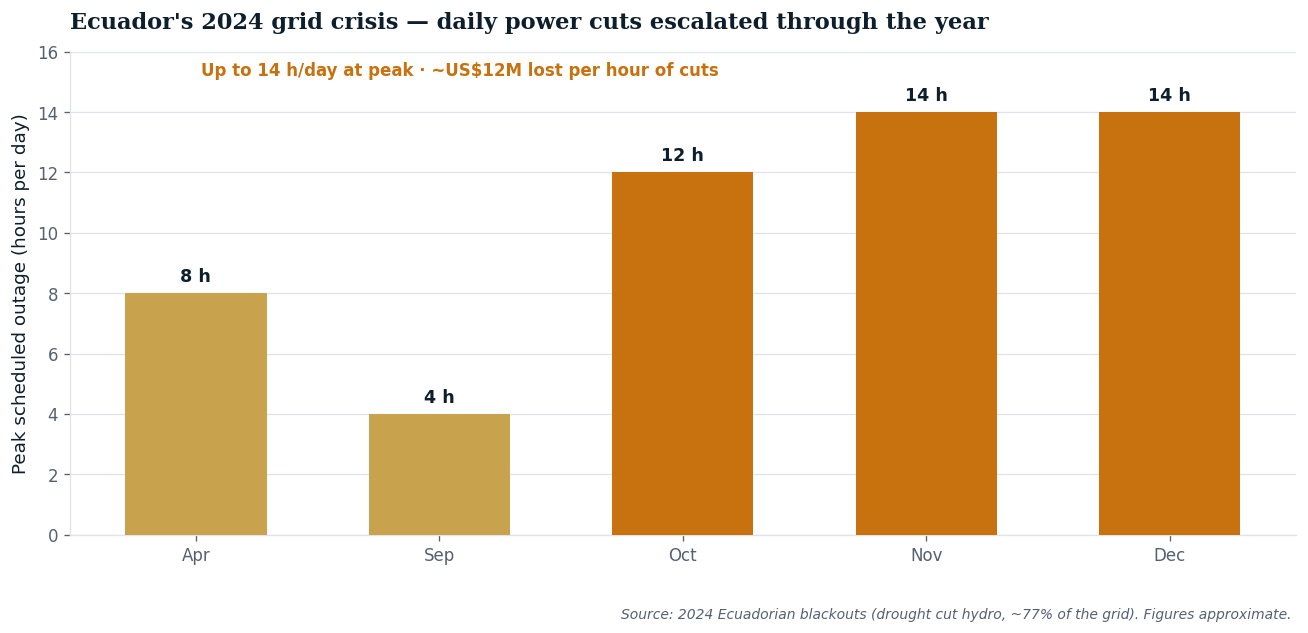
In late 2024, Ecuador offered the whole region a preview. A historic drought drained the reservoirs behind a grid that draws roughly three-quarters of its power from hydro, and the country moved to scheduled blackouts of up to 14 hours a day. Estimated economic losses ran to around US$12 million for every hour of cuts. It was an extreme case, but the underlying ingredients — heavy reliance on one resource, climate variability and years of under-investment in new capacity — are not unique to Ecuador.
For industry, the lesson is simple: grid reliability has become a planning assumption you can no longer make for free. The operations that kept producing through the crisis were the ones that had already treated on-site power as core infrastructure — not an afterthought.
The real cost of an unreliable grid
The headline macro figures understate what an outage does to a single site. Beyond the lost production hours, there is spoiled product and material, interrupted processes that must be purged and restarted, damaged equipment from unplanned stops, idle labour, missed contractual commitments, and — in sectors like mining, cement or food processing — safety and integrity risks when critical systems drop. For a producing operation, a few hours without power can cost far more than the generation that would have prevented it.
Plan for structural instability, not a one-off
It is tempting to treat a crisis as a freak event and wait for it to pass. But where a grid leans heavily on hydro, sits exposed to increasingly erratic rainfall, and has added little firm capacity as demand has grown, instability is structural. Some markets in the region live with chronic unreliability year-round. The prudent posture is to design for interruption as a normal condition — and to size the response to the outages that actually occur, which as Ecuador showed can mean not minutes, but many hours at a stretch.
The backup spectrum
"Backup" covers a range of postures, and the right one depends on how bad and how frequent the outages are:
- Standby. The grid is your main supply; on-site generation starts and takes over when it fails. Right for occasional, short interruptions.
- Grid-parallel / peak shaving. You run alongside the grid — trimming demand charges and expensive peaks in normal times, and carrying the load seamlessly when the grid drops.
- Prime / island. Where the grid is unreliable enough, you become your own utility, generating on-site continuously and treating the grid (if present) as the backup. Common on remote sites and increasingly rational where outages run to hours a day.
Four strategies that keep the load up
Whatever the posture, resilient on-site power rests on the same building blocks:
1 · Fast, automatic changeover
When the grid fails, the plant should recover it without anyone in the loop. An Automatic Transfer Switch (ATS) senses the failure and transfers the load to on-site generation in seconds — the difference between a momentary dip and a stoppage.
2 · Redundancy — no single point of failure
A backup that is itself a single machine is only half a plan. N+1 redundancy — one more generating unit than the load strictly requires — means a fault or a service interval on any one unit never takes the site down. Combined with parallel synchronization, the fleet simply carries on.
3 · Fuel security — enough to outlast the outage
A 12-hour outage is a fuel problem as much as a generation one. Diesel autonomy has to be sized to the real outage duration — tanks, not token reserves — while a piped or on-site gas supply can sidestep the logistics entirely. Getting fuel wrong turns a capable plant into one that runs out halfway through the night.
4 · Modularity and fast deployment
Crises do not wait for construction schedules. Containerized units can be delivered and commissioned in weeks rather than quarters, deployed close to the load, and scaled in parallel as needs grow — so resilience can be added at the pace the situation demands.
Three questions to size the backup
How fast must power return (seamless, or is a brief break acceptable)? How long must it last (fuel autonomy for the worst realistic outage)? How much of the load is truly critical (the whole site, or the processes that must never stop)? The answers set the transfer scheme, the fuel and tankage, and the plant size.
Where Istmica fits
Resilience is an engineering problem before it is an equipment purchase. We start from your load, your tolerance for interruption and the outages your grid actually delivers, then design a brand-independent, right-sized response — ATS-backed standby, N+1 redundancy, fuel autonomy matched to real outage durations, and containerized units that deploy fast and scale. The aim is straightforward: when the grid gives out, your operation does not.
Is your operation exposed to grid outages?
Tell us your critical load, how long outages last and how fast power must return — our engineers will design a backup strategy sized to your risk, with a USD proposal.
Request a Power Assessment →Sources & further reading
Wikipedia — 2024 Ecuadorian blackouts · Al Jazeera — How rolling blackouts transformed life in Ecuador · CBS News — Ecuador imposing blackouts as drought saps hydro capacity