
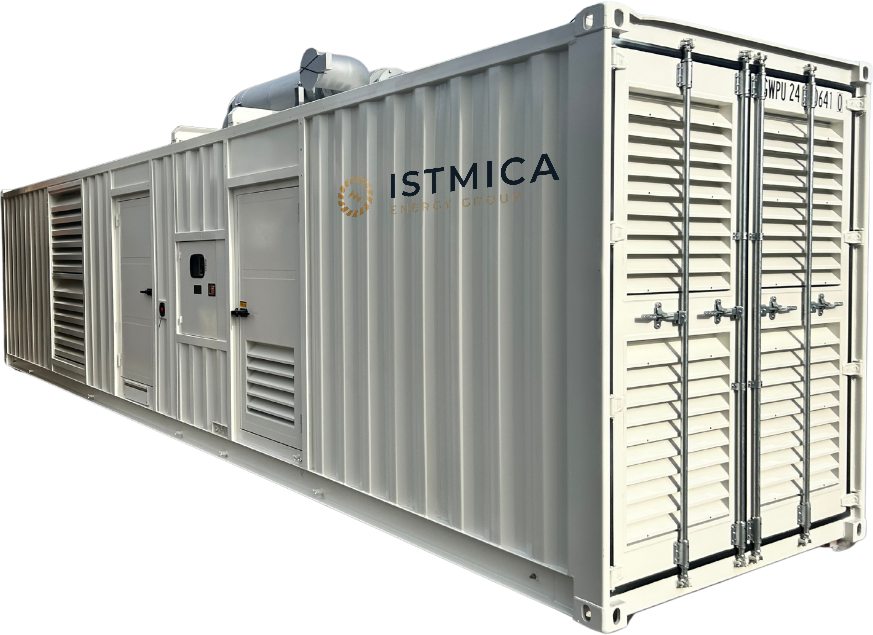
When a site needs power fast — and needs it to grow without a rebuild every time the load changes — a containerized generator is usually the right starting point.
A containerized generator is a complete diesel or gas power plant — engine, alternator, controls, fuel system and protection — pre-integrated inside a standard ISO shipping container at the factory. It moves on any truck, rail wagon or vessel that handles containers, lands on a prepared concrete pad, and connects: no civil power-house to build, no months of on-site assembly. For mining, oil & gas, industrial and government sites across Latin America and the Caribbean, that speed of deployment is often the deciding factor between containerized and conventional power.
Built to add capacity, not just supply it
Because the format is standardized, capacity becomes something you add rather than something you have to predict years in advance. A 20-foot unit carries a single genset; a 40-foot unit carries two. Units are engineered to run individually or to be synchronized in parallel — matching frequency, voltage and phase before connecting to a common busbar — so a site can start with the capacity it needs today and add containers, one at a time, as the load grows, without ever taking the existing supply offline.
An automatic load-control system watches real demand on the busbar and brings units online or takes them offline to match it, so the fleet runs close to its most efficient loading instead of several engines idling at part load. Alongside the running units, a spare generating unit on standby — tied in through an Automatic Transfer Switch (ATS) — gives the plant N+1 redundancy: one fault becomes a non-event instead of a shutdown.
Typical containerized configuration
| Format | 20'HQ (1 genset) · 40'HQ (2 gensets), standard ISO container |
| Output per container | 1.1 MW (20'HQ) · 2.2 MW (40'HQ) |
| Rated capacity | 1,375 kVA (20'HQ) · 2,750 kVA (40'HQ) |
| Fuel | Diesel or natural / associated gas, dual-fuel available |
| Output voltage | 440 V – 11.5 kV |
| Frequency | 50 or 60 Hz |
| Control & monitoring | AMF / PLC panel, automatic electric start, remote monitoring |
| Protection | IP44 standard (IP54 / IP63 optional) |
| Acoustic | Sound-attenuated (soundproof) container available |
| Installation | Plug & play |
Where containerized power fits
- Off-grid and grid-edge mining — modular capacity that scales with each phase of the mine, sized for altitude and site conditions from day one.
- Oil & gas sites — fast standby or primary power, including configurations that put otherwise-flared associated gas to work on site.
- Industrial parks and heavy industry — reliable primary or peak-shaving power where grid supply is constrained or unreliable.
- Government and utility standby — rapid deployment for critical facilities that cannot tolerate extended outages.
Engineered to your site, not sold off a spec sheet
Because we are brand-independent, a containerized recommendation starts with your load, your fuel supply and your site conditions — altitude, ambient temperature and humidity all reduce a generator's real output through derating, which is exactly why sizing has to happen before the container ships, not after. Where associated gas is available, or where diesel logistics are the bigger constraint, the fuel decision follows the same logic — see our full comparison of gas, diesel and HFO. For a deeper look at how containerized, synchronized power is already changing mine-site energy in South America, read why containerized power is reshaping off-grid mining.
Need containerized power sized to your site?
Tell us your load, your site conditions and your fuel supply — our engineers will design a containerized configuration sized to your operation, with a USD proposal.
Request a Power Assessment →