
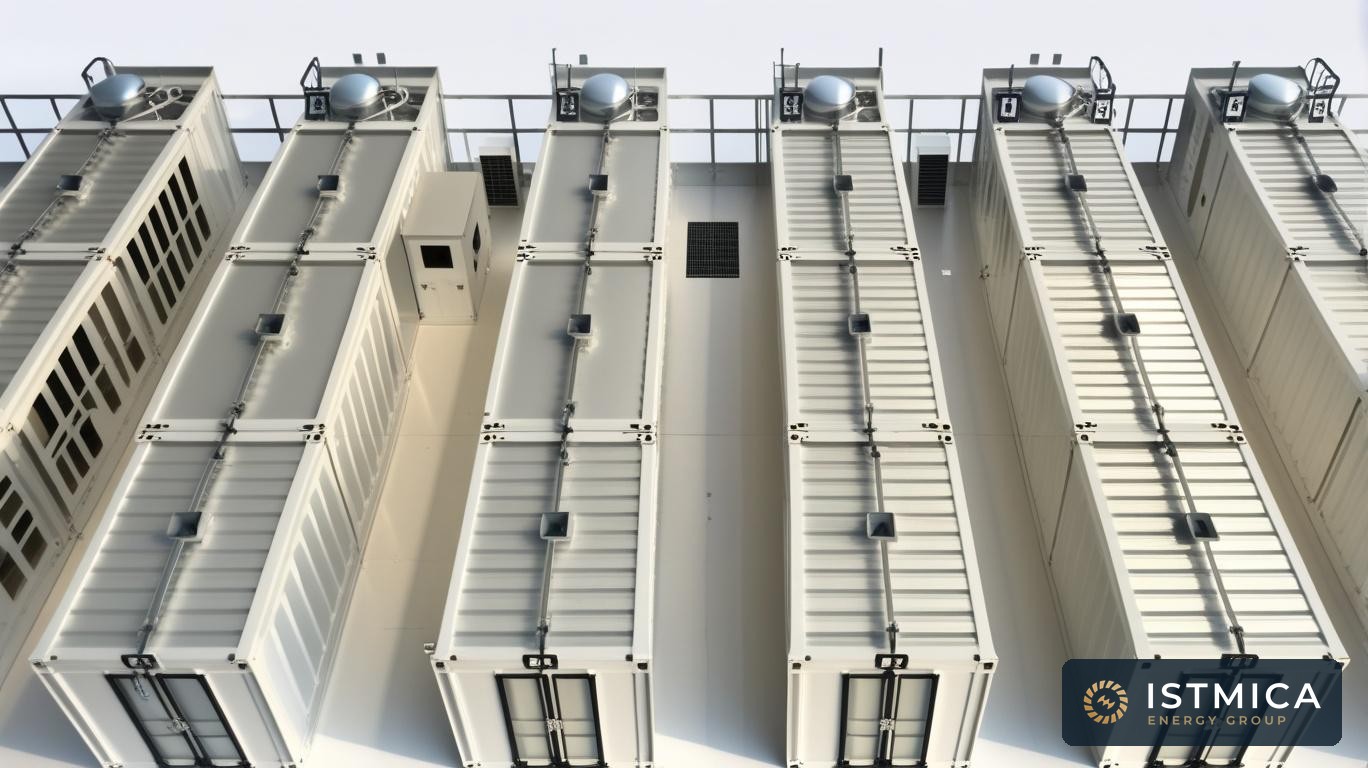
At most mining sites in the Andes, the Amazon basin and remote frontier corridors, power is not a utility connection — it's infrastructure you have to build and own.
South America holds some of the world's richest copper, gold and lithium reserves, and much of it sits far from any dependable grid. The traditional choices — a transmission line over punishing terrain, or a single permanent diesel plant sized for a guess at peak demand — are slow, capital-heavy and inflexible, and they tend to lock a mine into a fixed block of capacity years before anyone knows how the operation will actually ramp.
Power that scales with the mine, not ahead of it
Mining loads rarely stand still: a new grinding line, a dewatering pump, or an exploration extension can shift the peak overnight. Our approach is modular, containerized generation that synchronizes in parallel — the site runs a bank of standardized units, deployed in weeks and added container by container as the load grows, controlled as a single system rather than committed to a fixed footprint on day one.
An automatic load-control system keeps every running unit close to its most efficient loading, which typically cuts fuel consumption by up to 30% compared with a static, oversized plant — a decisive number on a site where diesel or gas is trucked or piped in over long distances. Alongside the running units, a spare generating unit on standby, tied in through an Automatic Transfer Switch (ATS), gives the site N+1 redundancy, so a fault in one machine is a non-event for production rather than a stoppage measured in lost tonnes.
Sizing considerations for Andean & remote mine sites
| Typical site altitude | 3,000–4,500 m (Andean operations) |
| Altitude derating | ~3–4% output loss per 300 m above 1,000 m |
| Fuel options | Diesel, natural or associated gas, dual-fuel |
| Redundancy | N+1 standby unit, ATS-backed automatic transfer |
| Fuel savings vs. static plant | Up to 30% via automatic load-following control |
| Deployment | Containerized units, weeks not quarters |
Sizing for altitude from the start
A generator's nameplate rating is quoted at reference conditions, and Andean mine sites are rarely reference conditions — thinner air at altitude, plus high ambient temperature and humidity in some corridors, all reduce a generator's real output through derating. A plant specified at sea level can fall well short once installed at 3,000 or 4,000 metres. Because containerized capacity is modular, the derated output at your real site conditions is met by adding units at the design stage, not by discovering a shortfall after commissioning.
Built for how mining sites actually operate
- Off-grid and grid-edge sites — full primary power where no grid connection exists or reaches far enough.
- Phased development — start with the capacity the mine needs today, add containers as each phase comes online.
- Remote logistics — units ship on any truck, rail or vessel that moves containers, with no civil power-house to build.
- Continuous operation — N+1 redundancy and automatic transfer keep production running through faults and maintenance.
For a deeper look at how containerized, synchronized power is already changing mine-site energy across the region, read why containerized power is reshaping off-grid mining, and see our full framework for choosing between gas, diesel and HFO depending on what fuel your site can bring in.
Planning power for a mine site?
Tell us your load, your altitude and site conditions, and your fuel supply — our engineers will design a containerized configuration sized to your operation, with a USD proposal.
Request a Power Assessment →